Posts

Showing posts with the label redaction

"Boiled" Millet Wine

Image
I brought one new wine to King and Queens Arts and Sciences : a "boiled" millet wine.  This is the first wine for the second "exceptional" yeast cake recipe in Qimin Yaoshu - the yeast cakes I'm actually using at the moment .  It's got something weird going on.  Let's dive in. YE2W1 造神麴黍米酒方:To make proso millet wine using exceptional yeast cakes 細剉麴,燥曝之。麴一斗,水九斗,米三石。須多作者,率以此加之。其甕大小任人耳。 Finely file the yeast cakes, and air them in the sun to dry.  For one dou of yeast cakes, use nine dou of water, and three dan [30 dou ] of grain.  If you need to make more, keep the ingredients in this proportion.  Use an appropriately sized weng . 桑欲落時作,可得周年停。初下用米一石,次酘五斗,又四斗,又三斗,以漸待米消既酘,無令勢不相及。 When the mulberry trees lose their leaves [Chinese months 9 or 10, mid October - mid December].  First, add one dan of grain, then add five dou , then four dou , and then three dou , adding each after the grain has dispersed [note that this only adds up to 2.2...

Wine that tastes good!

Image
Having just made new yeast cakes , I put them to good use in a batch of millet wine and rice wine following the recipe I call YE1W1 and YE2W2, as they're the first and second wines (W1, W2) listed under the first exceptional yeast cakes (YE1).  They came out really good! The recipe: Millet or Rice Wine à la Yuán Púshè This volume will fit in a 1 gallon wide-mouthed fermenter, barely. Ingredients and Tools ¼ cup powdered exceptional yeast cakes, about one cake.  But do measure. 5.25 cups dry millet or 4.5 cups dry white sticky rice Water 1 gallon, wide-mouthed fermenter - cooked grain can’t go through a narrow mouth Cheesecloth Optionally, liner silk or some other filter fabric finer than your cheesecloth Mortar and pestle Directions Dry the yeast cakes completely and scrub them clean several times. Grate, and then grind the yeast cakes in a mortar.  Soak them in 1.25 cups water for three days until they start to bubble.  Add to...

Brewing Zhang Bangji's 12th Century Recipe for Su Dongpo's Mead

Image
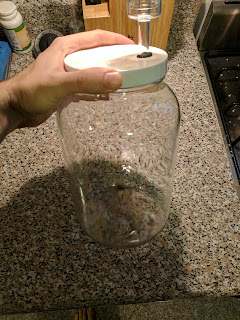
In the hunt for Song dynasty poet Su Dongpo 's mead recipe, we discovered last time that his recipe for "honey wine" is probably not using honey as a primary fermentable. But we do have Zhang Bangji's report on Su Dongpo's recipe .  I have no idea whether it's really  Su Dongpo's recipe, but at some point it doesn't matter.  They were contemporaries, and his recipe is just as reasonable and period as Su Dongpo's unknown recipe for mead. I'm brewing a one gallon batch because I have my shiny new weng -simulant, a large-mouthed jar.  The local homebrew store had them, and I think they'll do well.  It comes with a lid with a hole for an airlock, but because it's got a mouth and isn't a bowl, fitting cloth over it should also be easy.  How much air to allow in is a battle for another day, so I'm going to go the modern route on this one and use an airlock. This thing holds a gallon, so I'm going to scale the recipe to...

A Mead Recipe

Image
Recently, I posted about my search for a Chinese mead recipe, and some potential leads. Today, I cracked open the English-language textbook on Chinese food and beverage production, Science and Civilisation in China Volume 6 Biology and Biological Technology Part V: Fermentation and Food Science , and it contains a section on mead (page 246)! It backs up my research so far, although it doesn't include the really early archaeological finds because they were excavated after it was published.  There are a few mentions of honey used for various things in the classical period, but it isn't until the Tang dynasty in about 650 that we start to see references to mead. The Song dynasty author Zhang Bangji (張邦基) recorded in his book Random Notes from the Scholar's Cottage  ( 《墨莊漫錄》)  what he claims is Su Dongpo's recipe for the mead mentioned in the poem I translated last time.   Science and Civilisation  has a translation, but I decided to make my own before I read...

Wine from the Yeast Cakes

Image
Now that the yeast cakes are ready , and nice and dry (they firmed up quite nicely after drying), I'm ready to start making wine from them. Qimin Yaoshu  is structured around the yeast cakes, and to help keep them straight, I'm numbering them and the wines that are attached to each cake recipe.  These yeast cakes are the first "exceptional" yeast cakes, so I'm calling them YE1, and below are the translated directions to make two different wines using them, a millet wine (YE1W1) and a rice wine (YE1W2). I'm starting the process of making these now, and I'll report back once I have some more photos to show.  For sizing, the recipe clearly tells us that one volume of yeast cakes is enough for 21 or 18 volumes of grain, which means something like 60 volumes of alcohol, if you figure that you get about as much liquid out as cooked grain, which is about three times the volume of the dry grain. Since I'm making this to hopefully panel at  ...