Posts

I Found a Better Name

Image
I took a trip to the Metropolitan Museum of Art in late September because I thought there was an exhibit on Chinese laquer ware that was going to close soon. I had the year wrong, it's opening and closing in 2017.  Whoops. Instead, I took a stroll through the Chinese collection, on the lookout for drinking cups I could replicate, and took a ton of photos for my friends with research interests.  There was a lot of debate about what exactly this woman is holding happening in the SCA China facebook group , and I happened to be walking past  the statue at the time so I took some video and helped answer the question. I also took a look at the scrolls section since I have friends who do beautiful calligraphy and are always looking for ideas. I came across this beautiful scroll : Which is titled, politely, "Drinking and composing poetry."  Except it isn't.  Here's the title colophon Read right-to-left, these are foot-high characters that read LITERAT...

Where We Stand, Where We Go From here

Image
Pennsic was a whirlwind of activity, and despite me promising to update this blog "real soon I promise" life got in the way. I think this is a good time to take inventory of what I've figured out over the past year or so.  There are a lot of unanswered questions, but I've made a ton of progress nailing down this process. Yeast Cakes I've got a recipe for "exceptional" yeast cakes that worked once, last year. I tried to make it a month ago and it rotted 😑 But hey, it worked once. I also learned that the warning about "don't store this in a sealed container or it'll turn black and get gross" wasn't kidding, since my cakes did just that.  Mr. Jia wasn't joking, apparently. The recipe as I handed it out at Pennsic is posted at the bottom. Brewing I made one rice wine for Pennsic that was delightful.  Sweet, dark, saucy, it was great.  I didn't get to panel it, sadly.  I made one short-wine a while ago ...

Mijiaya, or Going Retro

Image
On the outskirts of Xi'an, the Chan River flows.  It eventually meets the Wei River, which flows into the Yellow river.  On a dusty terrace above the river is a site called Mijiaya , where excavations in the 2000s uncovered pottery dating from 3400 BCE to 2000 BCE. Some of the earliest potter, from 3400 BCE to 2900 BCE, the late Yangshao period , includes parts of an amphora, an urn and a funnel.  This May, some archaeologists at Stanford published an analysis of residue on the pottery: http://www.pnas.org/content/early/2016/05/18/1601465113 It's malted barley, along with millet, something called Job's tears, and some other starches. I think this is awesome!  We know that alcohol production in China predates writing.   The Records of the Grand Historian  ( 史記 ) from 50 BCE discusses King Zhou, the last king of the Shang dynasty, who reigned 1075–1046 BCE: [He] made a pond of wine, hung the trees with meat, made men and women chase each other ab...

Successfully Cooking Rice

Image
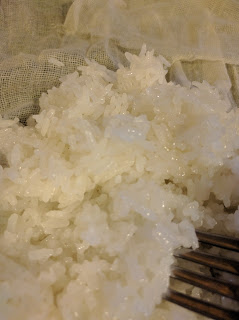
I posted about rice cooking methods a little while ago, with mixed success, but I think I've got it down now.  The secret? Soak the rice overnight . Delicious and sticky after steaming for 20 minutes I had initially thought that I could measure hydration of the rice by how much it expanded, and since it's done expanding after about an hour or so I stopped soaking there.  But what a difference soaking overnight makes! Soaking didn't seem to affect the millet much, which might be why Qimin Yaoshu  says to steam it twice.  It's also probably why I didn't have as much trouble with millet wines. Note how some grains are fluffy and some are still dark I tried steaming a second time since I was steaming the millet anyway, and  poured a little bit of cool water over the rice and millet before returning it to the steamer.  The rice was 100% cooked throughout, as was the millet, although the millet feels a bit dry to the touch. This work is lic...

Mistakes Happen

Image
I'm trying to get a short wine recipe to work, but it's tricky. One of the problems is how long to incubate the yeast cakes before using them.  The recipe says: 浸麴發如魚眼湯。 Soak the yeast cakes until they bubble with bubbles the size of fish eyes. And so I waited for bubbles.  They never came, and one day when I checked on the brew... Sadness.  It's covered in a slick of fungus. This work is licensed under a  Creative Commons Attribution-ShareAlike 4.0 International License . 

Methods for Cooking Rice

Image
Previously, I'd struggled with adequately hydrating millet and rice while steaming.  You'd think this wouldn't be a problem, but once the grain is at the temperature of the steam, no more steam will condense on it.  If it's not already wet, it gets hot, but not really cooked. Steaming grain twice (letting it cool in between) helped, as did wrapping the grain in cloth, but not enough.  I was missing something. Reading through  Science and Civilisation in China,  Volume 6, Part 5,  Fermentations and Food Science , which is far and away the most complete and well-researched English-language book on the topic of Chinese brewing, I've spotted a hint. A line from a poem in the  Shi Jing , the Classic of Poetry, this one from the 10th to 9th century BCE: 生民 ... 誕我祀如何?或舂或揄,或簸或蹂。釋之 叟叟 ,烝之浮浮。 ... The given translation for this is: We pound the grain, we bale it out, We sift, we tread, We wash it, we  soak  it, We steam it through...

Pressing and Straining

Image
Chinese grain wines are fermented on the mash, which means that if you want to get something drinkable out the other end, you need to separate the grain from the liquor. I initially was assuming this was happening without firm evidence, because the fermented mash is not wine by any means. Blorp I've used cheesecloth with some success to filter it, but it's a little difficult because you have to squeeze it pretty hard to get the wine out, or else sensuously massage the bag of mash with your hands to allow it to continue draining.  I think that it's hard to drain because the grain particles are pretty fine, and clog up the filter.  Beer mashes can run into this problem occasionally, but don't usually because they're less porridge-like since the grain isn't cooked. Straining through cheesecloth has been what I've been doing, but you still end up with a lot  of sediment coming out of the bag. Some of this sediment will settle out, particularly...