Posts

Wine that tastes good!

Image
Having just made new yeast cakes , I put them to good use in a batch of millet wine and rice wine following the recipe I call YE1W1 and YE2W2, as they're the first and second wines (W1, W2) listed under the first exceptional yeast cakes (YE1).  They came out really good! The recipe: Millet or Rice Wine à la Yuán Púshè This volume will fit in a 1 gallon wide-mouthed fermenter, barely. Ingredients and Tools ¼ cup powdered exceptional yeast cakes, about one cake.  But do measure. 5.25 cups dry millet or 4.5 cups dry white sticky rice Water 1 gallon, wide-mouthed fermenter - cooked grain can’t go through a narrow mouth Cheesecloth Optionally, liner silk or some other filter fabric finer than your cheesecloth Mortar and pestle Directions Dry the yeast cakes completely and scrub them clean several times. Grate, and then grind the yeast cakes in a mortar.  Soak them in 1.25 cups water for three days until they start to bubble.  Add to...

New Yeast Cakes

Image
My first batch of yeast cakes is running out, and I think they had some process issues, so I wanted to make a new batch. I decided to try the second yeast cake recipe: YE2 又造神麴法:Another method for making exceptional yeast cakes 其麥蒸、炒、生三種齊等,與前同;但無復阡陌、酒脯、湯餅、祭麴王及童子手團之事矣。 Take equal quantities of steamed, stir-fried and fresh wheat, and join them as in the previous recipe, but without the north-south cross, the offering of alcohol and dried fruit/meat, the cooked noodles, offering to the “yeast cake king” or having children shape the cakes. 預前事麥三種,合和細磨之。七月上寅日作麴。溲欲剛,擣欲精細,作熟。餅用圓鐵範,令徑五寸,厚一寸五分,於平板上,令壯士熟踏之。以杙刺作孔。 Prepare the three kinds of wheat as before, join them and finely grind them.  On the third day of the seventh month, make the yeast cakes.  Wet them so they are “firm [more water than “just add a little”].”  Pound the mixture until it is evenly mixed and fine.   Make it into cakes using a round iron mold, 5 thumb-joints across, and one and half thumb...

Starting A New Blog for Non-Brewing Topics

http://sundries.alecstory.org I intend to keep this one focused on brewing, but some of this audience might find non-brewing medieval topics interesting.

Polished Millet

Image
As I wrote a while back , if you buy hulled millet in the grocery store or online, and you steam it, you don't get great results.  A lot of the grains don't cook completely, which leads to problems fermenting. The problem is really that the grains are unpolished and still have a layer of bran on them - they're the brown rice equivalent of millet.  I can buy white rice, but not "white" millet. The solution is to use more power . My food processor has two blades which looked reasonable to use.  One is the regular cutting blade (note that Cuisinart recently had a blade recall , which affected mine), and the other is the shorter-armed, plastic dough blade. I tried both, for sixty seconds continuously: Unprocessed Dough Blade Knife Blade The dough blade didn't really change the grains, but the knife blade did - the grains had a lot more powder, and when washed were much whiter: Part of the problem with the dough blade is that it doesn...

Sugared Noodles

Image
I translated another few recipes for the cooks mailing list. I had initially thought that "yellow cocoon candy" would be something like cotton candy, or pişmaniye , but this is actually noodles dry-fried and soaked in syrup.  Still neat!  I wonder how these taste. 《食次》曰:From The Sequence of Food [Lost Northern and Southern Dynasties era text on food, which survives in part here.]: 「白繭糖法:熟炊秫稻米飯,及熱于杵臼淨者舂之為𥻓 ,須令極熟,勿令有米粒。 “To make white cocoon candy [actually a kind of friend glutinous rice noodle rolled in sugar to form pellets]: take fully cooked proso millet or rice [commentary thinks it’s glutinous, but I’m not sure from the text], pound it completely in a mortar as if you are making rice cakes.  You must fully pound it, and not allow any grains to remain. 幹為餅:法,厚二分許。 Form into a cake [cakes?]: in the standard way, two fen or so thick. 日曝小燥,刀𠠫為長條,廣二分;乃斜裁之,大如棗核,兩頭尖。 Dry in the sun until a little dry, and cut it using a knife in straight divisions to fo...

Brewing Zhang Bangji's 12th Century Recipe for Su Dongpo's Mead

Image
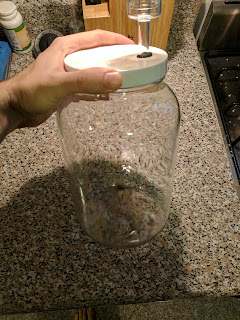
In the hunt for Song dynasty poet Su Dongpo 's mead recipe, we discovered last time that his recipe for "honey wine" is probably not using honey as a primary fermentable. But we do have Zhang Bangji's report on Su Dongpo's recipe .  I have no idea whether it's really  Su Dongpo's recipe, but at some point it doesn't matter.  They were contemporaries, and his recipe is just as reasonable and period as Su Dongpo's unknown recipe for mead. I'm brewing a one gallon batch because I have my shiny new weng -simulant, a large-mouthed jar.  The local homebrew store had them, and I think they'll do well.  It comes with a lid with a hole for an airlock, but because it's got a mouth and isn't a bowl, fitting cloth over it should also be easy.  How much air to allow in is a battle for another day, so I'm going to go the modern route on this one and use an airlock. This thing holds a gallon, so I'm going to scale the recipe to...

Dairy Products

Image
That dastardly cooks mailing list has got me translating food recipes again. Qimin Yaoshu has a few recipes for three dairy products.  One, 酪 lào means something like "curdled milk" and is a variety of yogurt based on the recipe.  The next, 乾酪 gānlào "dry lao " is something we don't have a good western analogue for, but is basically dried milk skins.  Ever make pudding and peel off the dried skin?  Like that.  Finally, we have a recipe for what is probably butter, 酥 sū. It's interesting that the dry lao  doesn't add salt, like I would expect for something intended to keep.  It's also pretty funny how specific the author is about using dung as your fuel.  Which you should be sure to gather ahead of time! These recipes are in the middle of the chapter on raising sheep.  The recipe for lao  actually starts off with a page or so on how and when to milk your livestock - they weren't killing calves or lambs it seems, so th...